Work · Mindfulness business
The Amy Kuschel ecosystem
Amy Kuschel teaches mindfulness. Everything here exists so she can spend her time doing exactly that — teaching, recording, writing — while the software and a small crew of AI agents quietly handle the rest. Less admin. More creating.
The fun part
What Amy gets to do
Forget the architecture for a minute. Here's what running a business feels like when the busywork runs itself.
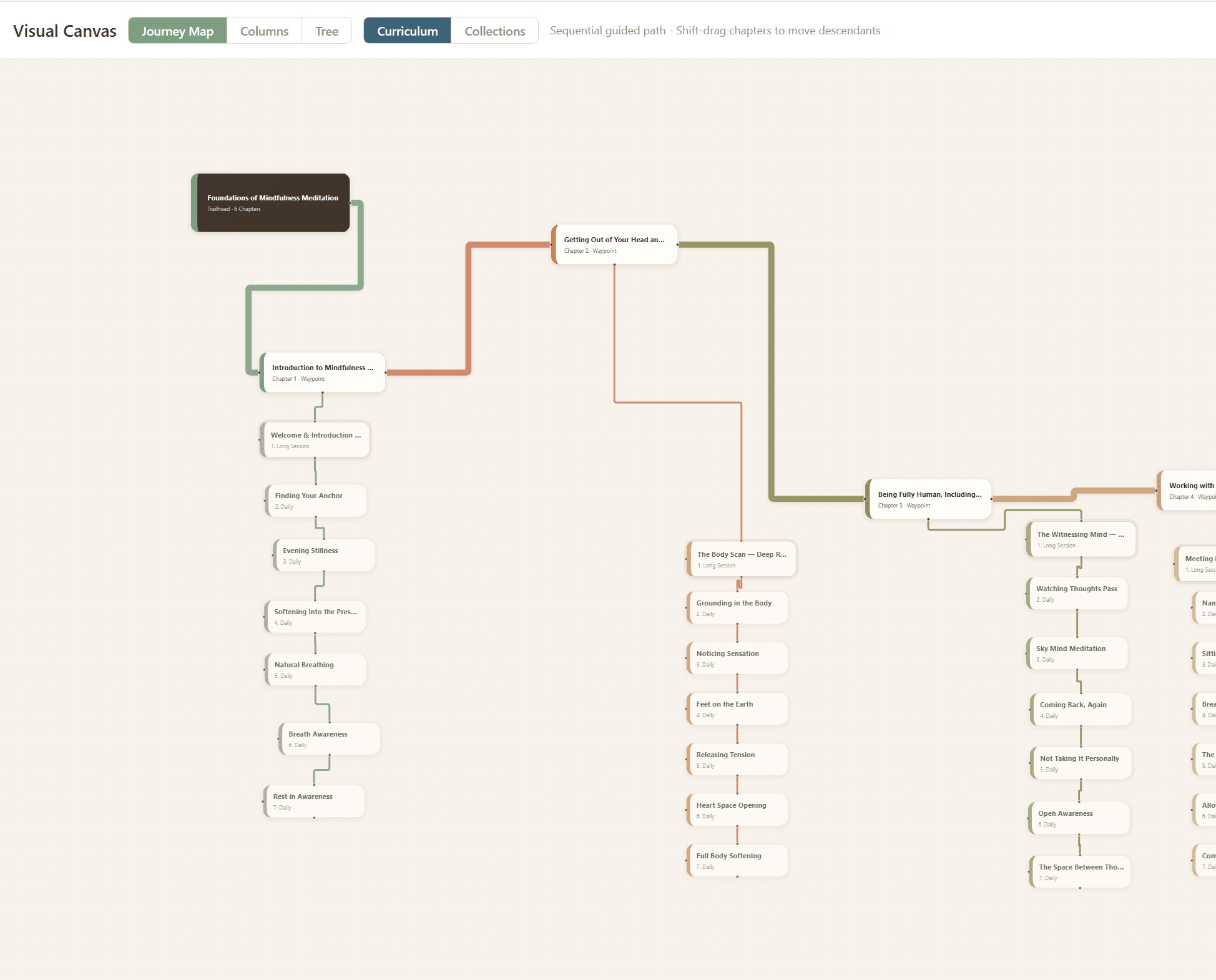
Shape a course by dragging it
Her meditation curriculum lives on a visual canvas: chapters and daily sessions laid out as a winding journey. Reordering a program is drag-and-drop, and the app updates for every subscriber.
Send a newsletter, see what lands
She writes; the platform handles signups, unsubscribes, and the analytics that show which ideas resonate — so the next newsletter starts from evidence, not guesswork.
One inbox for agent questions
When an agent needs her judgment, she gets a single email — not a firehose — and rules with five verdicts: approve, edit and approve, revise, or reject. Her answer teaches every agent involved.
Teach an agent her taste in 15 minutes
A plain-language interview turns her instincts into a weighted scorecard that pipelines actually branch on — so a near-miss opportunity gets a closer look instead of the bin.
The products
The suite around the practice
amykuschel.com
Marketing site, client portal, invoicing, document signing, newsletters, and an admin CRM — Next.js, Sanity CMS, Supabase, Stripe. The admin panel doubles as Amy's control surface for the agents: the Agent Inbox and a visual pipeline editor live there too.
Cue — meditation app
A React Native app delivering Amy's guided meditations as a structured beginner journey, managed through the canvas above. Depth over volume, by design.
Cue Audio — production tooling
Amy records short voice segments once; an FFmpeg pipeline assembles finished 5-to-20-minute meditations with silence detection and room tone. Deliberately not AI — boring tools where boring wins.
Admin AI assistant
A tool-calling assistant inside the admin panel with read-only access to contacts, appointments, invoices, and agent tasks — for when 'just ask' beats 'go click through four screens.'
The agents
Four names, four jobs
Sage
mindfulness research — daily literature scans, weekly briefings
Draper
marketing — stays synced to the app build, reviews brand voice
Squid
AI research — tracks the best model for each job
Scout
career — finds and scores opportunities for Amy
The whole crew runs on a single free-tier cloud VPS behind zero-trust access: each agent is one container with its own persona, memory silo, and dashboard. They never call each other directly. Work moves through a shared Postgres task queue, and a single database trigger routes each finished stage to the next — no orchestrator, nothing to babysit.
The canonical pipeline · job-inquiry
01 · Scout
Finds a wellness-industry job posting via web search, twice daily
02 · Scout
Scores the fit against Amy's profile — only 8+ advances
03 · Sage
Drafts an inquiry email in Amy's voice
04 · Gate
One email to Amy: job summary plus the draft
05 · Amy
Approve · Edit & approve · Revise · Reject — at the Agent Inbox
06 · Memory
Her verdict is written back for both agents to learn from
Behind the curtain
Two quiet tricks that make it feel effortless
The agents have already done the reading
When Amy publishes content in the CMS, webhooks write it into shared memory. The next time she asks Draper about a draft, he's already read it — no copy-paste, no catching anyone up.
Cheap reads, expensive thinking
Models are routed by cost tier, so routine scanning stays nearly free and the pricey reasoning is saved for moments that deserve it. One standalone weekly research script runs for about a tenth of a cent.
Say hello
Curious about any of this?
No pitch — the work is the pitch. If something here sparked an idea, or you'd like a closer look at how a piece of it fits together, I'd genuinely love to talk about it.
Say hello